14 April 2016

The “Archange”


My name is Joseph Rousseau. I was born in “La Flocellière” in Vendée on the 8th of June 1942. My brothers are called Michel, Daniel, and Jean-Marie. We worked with our father in the family business.

Since the 15th of August 1897, “l’Archange Saint Michel” has been protecting our district from the top of its bell tower. For sixty years, it bravely had to cope with storms.

In 1901, and again in 1932, a wing broke away from the Archangel. The repair was done by my grandfather and my father, who were zinc roofers at “La Flocellière”.

A few years later, I was also a zinc roofer and I was asked to clean the dragon and to repaint it. The year before, I had to climb up to the “Archange” to straighten the spear.

After a violent storm, on the 8th of February 1957, the statue tilted slightly. The iron master beam weighing 410 kg was twisted because of the rust.

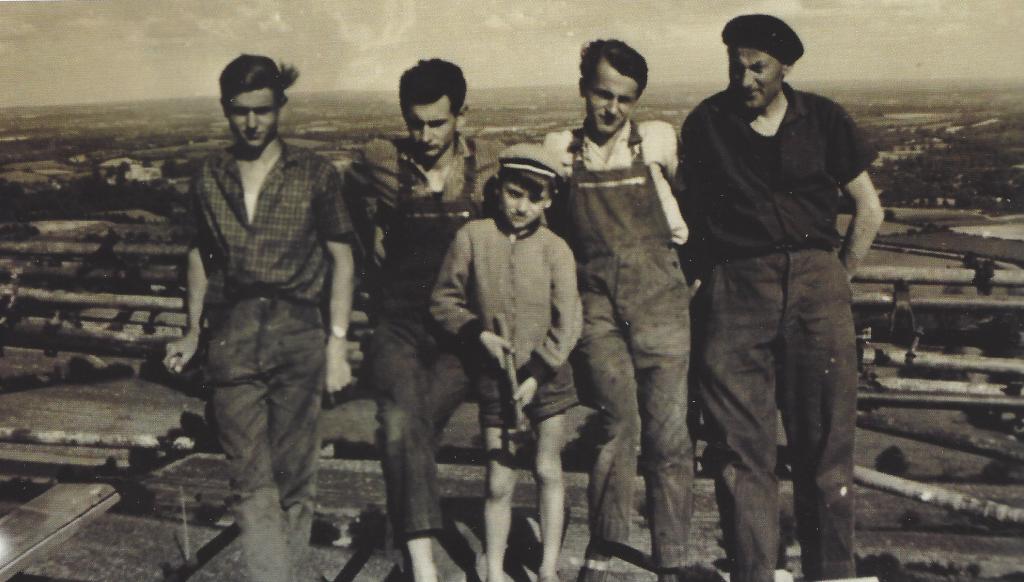
Very quickly, the mayor decided to take down the statue and to entrust it to my family who knew the statue. Scaffolding was set up at the top of the bell tower but the hardest part remained to be done. The statue was 9,2 meters tall, composed of nine pieces atttached to each other by 600 screws. Slowly but surely, we took down the statue and took it to our workshop. The repairs lasted two years.

In July 1961, the statue was taken down once again and put piece by piece in front of the church in order to allow helicopter transportation.

On Monday 7th of August, our company began putting up the scaffolding. At the end of that week, the first launch pad was installed so as to get the master beam. On Saturday 13th of August, the “Alouette II” helicopter came, flown by Mr Charles Schmitt.

Everything was ready. The hardest thing to do was to put the master beam at the top of the church. This first operation was carried out on Monday 14th of August at 6am. The weather was splendid, there was very little wind. We could work in favourable conditions. My father, my brothers and I were on the launch pad, waiting for the master beam.

The helicopter took off with its 410 kg charge. It was impressive and very dangerous… After a few scares, we managed to stabilize the beam which had arrived at the height of the launch pad. After that, we had to install the second part of the scaffolding in order to build the second launch pad.

On the morning of August 15th, the village was in great excitement. Everybody was coming to watch. It was incredible, I had never seen this before! Stands were built everywhere. People parked their cars in the meadow. Streets were shut to stop cars getting through.

We were on the launch pad trying to fix the last pieces in when we looked down on the village full of people. My heart was beating so fast. All of these people were there to see our work. At the end of the morning, the great celebration began. We were told after that there were approximately 30,000 people present!

The helicopter delivered the last pieces of the “Archange” and the pilot turned his machine around so as to show the spectators the pieces. It was 17:00. I was very tired but we had nearly finished. The “Archange” was the most important piece. Everybody was watching us. The helicopter gave us the precious burden and there was an explosion of joy. Needless to say, it was a fantastic event at the time.

My family and I were so proud. I jumped into my brothers’ arms. We had done it!

My brothers, my father and I had to continue assembling the pieces laid out on the launch pad. We had to put them one by one onto the master beam and screw them together. We had been working for three weeks to make sure the statue returned to its original state.

I was so happy I had done this work with my family. It was an extraordinary experience. It’s partly thanks to us that La Vendée still has its highest statue looking after our region. 

Article by Guillaume HUTIN,
grandson of Joseph Rousseau

A pioneer of agriculture...

M. Magne

My name is Marcel Magne and I was born in 1935 in Arches, a small village in the Cantal which is a beautiful region in the middle of France. I grew up during the 40s, with my brother Jean, surrounded by forest and fields. We were a small but dynamic farming community. My family was specialized in cow breeding.

When I was seven, my father was away fighting the Germans. He was caught and made captive. They sent him to Germany to work in their farms, as a prisoner. It was a strenuous time both mentally and physically for him, of course, but also for us at home waiting from sunrise to sunset for his return. Growing up without knowing if your father was alive was a terrible ordeal for me and the rest of my family.

In 1946, my father came home. Captivity had left its mark on him. However, he learned about their research. "They are fifteen years ahead in agriculture and breeding", he said. This was true since, in our region, progress had been slow. There are places far more advanced than we are so we decided that if we did not modernize then we would be left behind. We didn't even have running water in the house...

Progress was slow. In the 60s, the first tractor came. It was nothing compared to the ones today, of course, but it was a revolution on our family farm. We could have more fields, and by 1967, our surface had doubled.

I wanted to continue my father's work and his idea of progress. We built another stable in addition to the previous one. But we weren't rich enough to equip it totally. In fact, we had one trough for two stables. A problem? A solution. Every day we made the cows drink in the first stable, then we disassembled it and reassembled it in the second stable. Yes, it's not a job for lazy people!

During that time, I got married and we had four children: Nathalie, Marie-Pierre, Anne-Marie and Emmanuel. The last two are twins.

The next development came from my son Emmanuel, who went to an agricultural college and did an internship in a company: France Embryon. This company was new and carried out embryo sampling on cattle. That was exactly what we needed. Let me explain. In Auvergne, we have different breeds of cows, but two are interesting for meat production: the “Salers” and the “Charrolais”. We discovered by chance that a hybrid of them had a better tasting meat than the others. It had to have 50% exactly of each breed, if not, the resulting meat was not as tasty. The problem was that pure-breed Salers were rare and expensive. Moreover, a cow can only have two or three veals in its life. So here was our dilemma: either we made quality meat by having hybrids (and no pure-breed Salers for the next generation), or we bred Salers together. However, in case of the latter, the meat was far less tasty… Like I said, the solution came from embryo science: a cow can produce ten embryos from one fertilization. You can use them to inseminate another cow. And here lies the interest: whatever the breed of the inseminated cow is, the veal has the breed of its biological parents. In our situation, we could get pure-breed Salers using a hybrid cow which we had inseminated.

To work with France Embryon, my neighbours and I set up an association. It was a real success: I had both hybrids and pure-breed Salers. At the "Salon de l'Agriculture" in Paris, "Le Monde" wrote an article about me: I was among the first breeders to use this process. It was published in 1973 and by midday all the newspapers had been sold out!

I continued my work, and I got some great pedigrees: my best achievement as a breeder was a Saler that I sold in Scotland for one million Francs, and it won many contests there.

Today I'm no longer at the cutting edge of progress, but I keep running my farm with my son. I also had the great good fortune of having nine wonderful grandchildren. Last year, one of my daughters invited me to South Africa, it was amazing.

I have lived 80 years of a blessed life and I intend to enjoy it for a few more!

Article by Guillaume ANDRIEUX

Dr Maria...

I was born in Grzegorzewo, which was at the time a small village in the Polish countryside, at the end of 1935.

I had a peaceful childhood until the age of eight. But, from April to September 1943, the battle front crossed our region and included our village. We had to leave our home, bury our goods and run away, the fighting being just a few miles from us. As we didn’t find a safe place immediately; we hid in the forest an entire day. Those hours were the longest of my life. I remember being petrified with fear, the deafening sounds of shells echoing through my head and lost bullets whistling past above me.

We lived this way for six months, sleeping in stables, helping my mother with the injured soldiers who were begging for help, playing with dead corpses washed up on the river bank…

But the worst was yet to come. In December 1943, the Soviet police arrested my father and deported him to the Gulag somewhere in Siberia, leaving us behind. To survive, my mother and I went door to door, selling oil we had previously bought in town. As soon as we had saved a little, we would send a package to my father with some food so that he didn’t starve to death.

The years passed by. In 1946, I learned that I had a diseased hip. After a few months, I couldn’t move around anymore. I spend two years in Vilnius hospital. Finally, my leg healed, but it hadn’t grown during the illness, so it was shorter than the other. To avoid limping, I put a piece of wood in my shoe. The pain never really left…

After three years, three months and eight days, I could finally hold my father in my arms again. He had survived.

We lived the following years in misery, but we were grateful: war was over, my father had come back, and we had all survived. Communism was running the country. Our region became Lithuanian. I had to learn Russian to go to school. I remember it was not easy because I had always studied at home: school and teachers were something new but I tried to do my best and finally graduated.

In 1956, as the border between Poland and Lithuania reopened, I decided to leave the country which no longer felt my own. I managed to get a scholarship to study in Warsaw. When I had come out of the hospital a decade earlier, I said to the nurses I wanted to be a hero, just like them. Therefore, I entered the Medical University of Warsaw. I was starting a new life.

The rest of my existence was much like many other people’s. I got my diploma and worked as a pneumologist in hospitals. I met a lovely man at a dance who became my husband. We had two adorable children, Ania and Piotrek. I remember when we spent holidays camping in the North, in the forests, near lakes; those were good times. I guess we were just a happy family.

The years passed by. My children grew up. One left for France, the other comes and visits once or twice a week. We built a vacation house for our grandchildren, who used to spend the whole of summer with us.

I’ve never stopped working; even today I practice three times a week in my medical office.

I’m 80 years old now. I am happy with the life I had, even if there were hard times. I’ve learned that my own happiness rests on others, that is why I’ve done my best to help every person I meet. If I had a piece of advice to give it would be to remember to enjoy every moment, because life flies by so fast!

Article by Alexandra CROIZET

Life is but a dream...

Mme Oger

I was born on the first of May 1947 and my name is Marie-José Oger. It may seem like quite a common identity but I managed at least to fulfill my dream. Since I was a child, holding a pen has for me been something magical and gratifying. At that time we didn’t have paper, but my fervent desire to draw and write led me to express myself on anything I could get my hands on, including for example the house wallpaper! Despite many reprimands from my father, I couldn’t help myself. He decided to cover all the walls with Lino but it didn’t matter because the doors were enough for me. My father understood that nothing could stop me. In an effort to tame me, he began to take me around with him, to teach me various tasks. He taught me to dig the garden, paint the walls, help around the house, etc. These activities were for men, but I enjoyed them!

My mother also played a very important role in my life. She was very busy because of my little sisters, so she wasn’t often able to listen to me but this suited me well enough. I was successful in school, with always one idea in my mind: to make my parents proud of me. Quickly I was entrusted with “big girl” responsibilities. I was able to get to know my mother better and we become more close. She had real maternal gestures and was loving despite her disability. Indeed, my mother never learned to read or write but she said she had never wanted to do so anyway.

I realized how lucky I was to study. Then I decided one thing: later, I would be a teacher and I would teach children how to read and write and to my mother too, so it would perhaps make her life easier and help her discover new things. My mother said she was too old to learn and it wasn’t easy but she did. I decided to apply the same learning methods with my pupils.

My goal was reached: teaching children reading and writing. Actually, sharing my passion was wonderful. Conveying all this knowledge was essential for these children, and it allowed them to receive a gift they would use throughout their lives. It was fascinating to see how each child is different and learns as he wants. I felt useful, even essential, for others. This job was for me what I loved most in the world.

Then the years passed, I had a family, and my children learned to read very quickly. Later, retirement came but it was unthinkable for me to stop doing what l loved. I was bursting with ideas and my imagination was at its peak. The idea came to me to start writing a book, but not just any old novel. It was my gift to my mother for her eighty years, and was the first novel she ever fully read. It is called “La tartine au beurre” (“buttered toast”). Through this book I wanted to thank my parents for teaching me values such as respect and tolerance, essential principles that I later found in my music group.

I joined the Concert Band of Vic-le-Comte twenty five years ago. It is an association where we play music in the community. This association dates from 1865 and has never ceased to exist. The band is made up of a hundred musicians who share each week a common passion: music. Many pieces are played to entertain a large audience. So I decided to write a second book entitled “3 coeurs à la clef” (“Three hearts on the key signature”). It is an account of this association’s 150 year history. I wrote it also to demonstrate that, at a community level, there are values such as respect, tolerance, sharing, friendship, as well as plenty of emotions. When you read in between the “notes”, we discover a beautiful love story!

I then decided to write a third book. The story takes place in a country school made up of just one class, twenty three pupils, including three heroes, or rather their schoolbags. The schoolbags have the ability to speak, preserve, transport, etc. But this is only the beginning of the story…

If I have a piece of advice, it is: believe in your dreams! This is a bit of a cliché, but it sums up my life rather well. I am proud to say that my life was like a dream in which I did what I wanted to do!

Article by Emilie DURAND

A courageous fighter...

Our little house in Savoie

My name is Jean-Claude Buisson. I was born on the 12th of May 1943 in Modane. I grew up there, and I knew almost everybody in the village. I learnt about life there. I did my military service there too, which was an experience I didn’t particularly appreciate.

When I met my wife, I was 23 and she was 17. One year later we got married. When I announced to my family that I would marry this young and beautiful woman, who lived in the Allier, they were surprised because it was quite bizarre to marry a girl who was not from the region. This event was the beginning of a new life for me, because I had to move to my wife’s region. We had two children, Isabelle, who was born on the 12 July 1967, and Dominique, who was born on the 28th July 1972.

We built a house in Diou, which is a very smart village, near what is Le Pal today. I was an electrician, so I had to travel around France a lot. I also went to many foreign countries, like Egypt and Italy. I could only see my two daughters at the week-ends. That’s certainly the most important regret in my life.  But I had to earn money to feed my family.  But I was very happy because my wife looked after them. Our two beautiful and wonderful daughters became mothers, and we have four grandchildren who are our pride and joy.

The best days of my life were the births of my grandchildren. Two of them are German, because my eldest daughter married a German. The first one was born on the 12th of February 1998, and the other on the 19th of October 2001. And the two others are French, both born on the 23th November 1999 as they are twins. They are the two I share the most with, because the distance between Germany and the Allier is really big.

For nearly ten years, during the 1980s and the 1990s, we rebuilt a chalet which dates from the 1840s in the high mountains of Savoie. This place is very special because the Germans stayed there during the Second World War. Ten meters away, there is a very impressive shell hole. This little chalet was at that time the only thing that linked me to my old friends. When I retired, I wanted to make up for lost time. I knew it was too late for my daughter, but I wanted to be the best grandfather. So when my grandchildren were young we went there every year. They loved this place. In fact, I think that I’ve spent the best moments with my family there, even if it was quite drastic, because there was no comfort at all.  But they loved it and I’m quite proud of it.

As I said, I was an electrician. As such, I was exposed to a toxic substance: asbestos. I didn’t know that I was exposed to it for so many years because the company I worked for never mentioned it. In 2008, the bad news fell: I was diagnosed as having lung cancer. It was terrible for me. I had to do chemotherapy every three weeks. It made me sick for almost a week every time. I was also really sad, because I had just began to take care of my grandchildren, but I tried not to show it. I wanted them to have good memory of me. So I decided to fight for them, and for the rest of my family. I also filed a claim against the company. No one ever won a trial against them, so I knew that it would be a difficult thing to achieve, but I was quite confident because I knew they were wrong.

For four years I fought the cancer, and the company. I won my trial, and I’m quite proud of it, but unfortunately for my family, I lost against the illness...

Article by Simon MERCIER

Mother courage...

La Grange Neuve Farm, June 1994

My name is Marie Thérèse Combelle. I was born on the 8th of November 1939. As I was born at the start of the War, I didn’t meet my father until I was six years old. My mother told me that for more than three years, I refused to consider him as my father. I only started getting closer to him when I was eight.

When my father was mobilised, we were living in Paris. My mother decided to go back to her village in the Cantal. We lived in her brother’s farm, because my mother couldn’t manage to take care of me alone in Paris. My mother helped her brother in his large farm, La Grange Neuve.

I have two brothers and a sister. My two brothers are Jean and Raymond, named after my grandfathers’ names. And my sister is Andrée. We lived happily until I was seventeen. My father got cancer because of his detention in the labor camp during the War. He passed away within two months.

At the age of 24, I left my family and got married to Louis De Conquand. We lived in his parents’ house after their deaths. We took over the running of the family farm. I knew how to run a farm thanks to my upbringing.

We had four children: Martine and Annie, and Michel and Jean-Francois. We were never rich; we always had to be careful what we spent. When my husband was 56 years old, my first girl Martine left us for her job. She became a policewoman. My husband’s health got worse. Doctors diagnosed liver cancer. Louis succumbed after four months. His death was heart breaking for the entire family.

I was 53 when my husband died. I managed to run the farm for two years. With Martine and Jean-Francois gone, and two children still in my care, it was complicated. Martine sometimes helped. These were the most difficult years of my life. As I wasn’t able to manage alone and couldn’t ask my two children to stay in the family home, I decided to sell the animals and put all the meadows out to rent. My children encouraged me to take the driving test, to be more autonomous. My second boy left us to go to Clermont-Ferrand and became a cabinet maker. Finally, Annie left me to continue her studies in London.

This year, I will be 77. I live happily. If I feel lonely, I simply call up my children and I’m quickly back up on my feet again. I have seven grandchildren, aged three to twenty, who give me much love and joy: Mathilde, Louise, Léa, Maxime, Eva, Arthur and Alice. They really make me laugh each time I meet them.

I only have two regrets. The first is that my last girl, Annie, lives in Berlin with her family, and so I don’t see her more than twice a year. My second regret is the fact that my grandchildren never got to know their grandfather, Louis.

I now spend all day long in my garden, or I travel with the senior citizen’s club, or help my neighbours. I consider that my life is nearly over, and I hope that my children and grandchildren will continue to fight, like I did, so as to be proud of their lives.

Article by Louise VIGOUROUX,
Mme Combelle’s granddaughter

A humble life...

Mme Buisson

My name is Marine BUISSON and I was born on the 1st of November 1915 in Modane, a little town in Savoie. I lived in Le Bourget until I was 45 years old. I married Vincent BUISSON on the 2nd of July 1927. I had three children with him. The first one was Jean-Claude who was born on the 13th of July 1943. The second one was born on the 19th of May 1949 and I called him René. The third was called Renée (I will explain why later).

During my childhood, I always helped my father Dominique on our farm. But, I wasn't as lucky as my brothers Fernand and Benjamin because I had to go back to school on the 3rd of September, unlike them who returned to school in October because they had to help my father to bring the cows back to the village because of the snow in the mountain pasture. I was a very calm girl even if I was quite impulsive. I was a good pupil and, being the only girl in my family, my mum Adèle gave me everything so as to have a good husband and a good life.

I met Vincent, my husband, in 1925 during a village fete. He was from Le Bourget, so my family accepted him quite readily (it was frowned upon to get married to someone from outside the Vallée de la Maurienne).

I am of the generation which went through the War as adults. It was a very difficult time for Vincent and me, even if we were lucky to be together (as he wasn't able to fight). I lost so many friends during this war; it was a very difficult time because we always feared for our friends.

As I said before, I had three wonderful children. René died in 1953 of measles and my husband and I were just devastated. We kept on fighting though for our son Jean-Claude. In 1955, we chose to have another child and I really wanted to have a girl. On the 13th of March, this wonderful event happened as Renée was born. We chose her name in honor of René of course. I really wanted a girl because I felt quite alone in the house. I’m very proud of Jean-Claude because he was always determined to work for all the family. And, when my husband died of cancer, he didn’t hesitate to go to the factory to earn money even though he was only 14 years old. 

In 1965, my son Jean-Claude got married to Marie-Claude. In 1967, they had their first daughter, Isabelle. She was very clever and intelligent, as was her sister Dominique who was born in 1972. They visited me every holiday. They both had two boys. Dominique had twins. I see Dominique’s sons more often because Isabel’s sons live in Germany so it’s very difficult for them to come to Savoie.

I lived with my son Jean-Claude from 85 to 90 years old. When I turned 95, I went to the retirement home to be closer to Renée as she didn’t have a “real” family other than me. She was with me every day. She helped me to keep healthy by walking a little bit every day.

I have not always been favored by life, but I always managed with the support of all my family.

Marine BUISSON died at the age of 99.

Article by Vincent MERCIER